In short
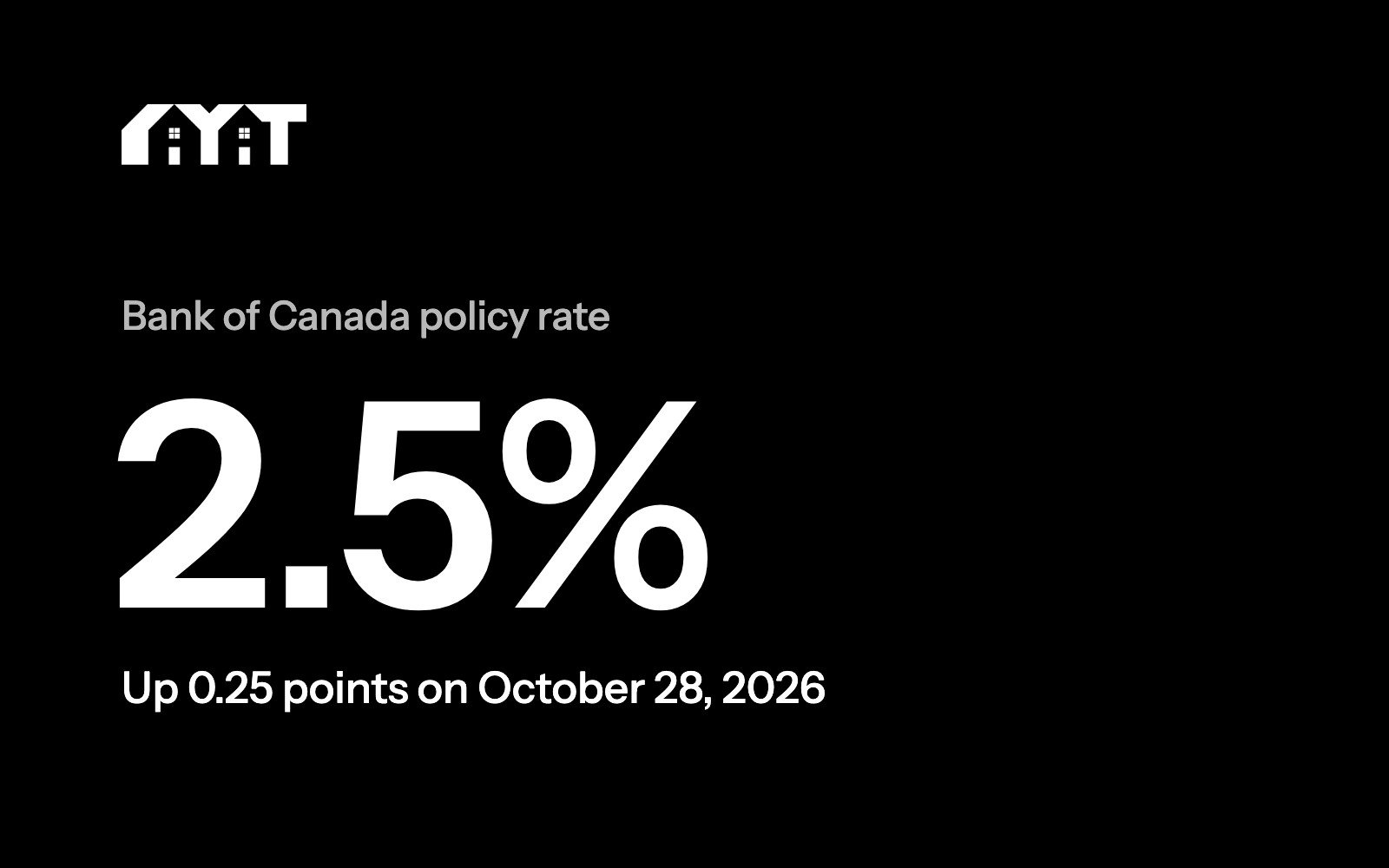
- On October 28, 2026, the Bank of Canada raised its policy rate by a quarter point to 2.5%, after holding it at 2.25% at every decision this year, and said a further increase could be needed.
- Variable-rate mortgages and home equity lines of credit follow your lender’s prime rate. On a $500,000 mortgage with 25 years left, a quarter-point rise adds about $70 a month to an adjustable payment.
- Fixed rates aren’t directly affected by the Bank’s decisions; lenders price them using bond yields, and they had already risen in September. If you plan to buy or renew soon, ask about holding a rate now.
The Bank of Canada raised its key interest rate on October 28 and signalled it may not be finished. Here is what it decided, why, and what it means if you own, plan to buy or plan to sell a home in the GTA. Figures are as of October 28, 2026.
What the Bank decided, and why
The Bank raised its target for the overnight rate, its policy rate, from 2.25% to 2.5%. It said inflation is “higher and more persistent” than it projected in July. With oil prices high, CPI inflation has been around 3% since April and is expected to reach about 3.5% by the end of the year. Excluding gasoline, inflation was 2.2% in September, and core measures remain close to 2%. The Bank raised its rate to reduce the risk that high energy prices spread to the prices of other goods and services.
It expects the economy to grow 1% in 2026 and 2% in 2027, and housing “to remain relatively weak”. On what comes next, it said “There could be a need to increase the policy rate further”, but that it will “proceed carefully”. Its next decision is on Wednesday, December 9.
What changes for you
| If you have | What happens now |
|---|---|
| A variable-rate mortgage with adjustable payments | Your payment rises when your lender raises its prime rate. |
| A variable-rate mortgage with fixed payments | Your payment stays the same, but more of it goes to interest. |
| A home equity line of credit | Your interest cost rises with prime. |
| A fixed-rate mortgage | Nothing changes until renewal. |
| A pre-approval with a rate hold | A held fixed rate is protected until the hold ends, if your finances don’t change. With a variable rate, ask whether the hold covers the rate or only the discount from prime. |
If you have a variable-rate mortgage or a line of credit
Variable rates and home equity lines of credit are priced from your lender’s prime rate, which is strongly influenced by the Bank of Canada’s rate. When the Bank cut in October 2025, for example, RBC announced the same day that its prime rate would fall from 4.70% to 4.45%, effective the next day. The big banks’ prime rate was 4.45% before this decision, so a matching rise would take it to 4.70%. Your lender will tell you its new prime rate and when it takes effect.
With an adjustable payment, your payment goes up. For example, on a $500,000 mortgage with 25 years left, a rise from 4.00% to 4.25% adds about $70 a month, from about $2,640 to about $2,710. With a fixed payment, the payment stays the same but more of it goes to interest: a quarter point is about $104 a month more interest on a $500,000 balance. If rates keep rising, you could reach your trigger rate, the rate at which your payment only covers interest, so ask your lender what yours is.
If you have a fixed rate or are renewing soon
A fixed-rate mortgage doesn’t change until renewal. Five-year fixed rates aren’t directly affected by the Bank’s decisions. Lenders price them using bond yields, and the five-year Government of Canada bond yield is an important factor. Those rates had already risen: in October, the Canadian Real Estate Association’s senior economist said a “step back” in many housing markets in September was “hardly surprising given the latest jump in fixed mortgage rates”. If you renew in the next few months, compare offers early and ask your lender whether it will hold a rate for you.
If you are buying
Get a pre-approval with a rate hold before you shop; BMO, for example, locks its pre-approval terms for 130 days. A higher rate also raises the rate you must qualify at. With at least 20% down at a federally regulated lender, that is the higher of 5.25% or your mortgage rate plus two percentage points, so a rise can lower the most you can borrow. With less than 20% down, a qualifying rate set by the federal Department of Finance applies instead. Our fall market update shows prices and choice across the GTA.
If you are selling
Higher borrowing costs can shrink some buyers’ budgets. In September, GTA homes sold for 98% of their list price on average, after an average of 34 days on the market for the listing that sold (51 days counting any earlier listings of the same home), TRREB reported. Price against today’s competing listings and recent sales, and get a current value estimate before you list.
If you own a rental or an investment condo
If your investment mortgage is variable, your carrying costs rise now. If it is fixed, test your cash flow at today’s rates before your renewal. Our guide for GTA condo investors deciding whether to sell or hold walks through the numbers.
What comes next
The Bank expects CPI inflation to average 3% in 2027 and to come down to 2% in the middle of 2028. Its next rate decision is on December 9.
Planning a move in the next year? We’ll look at your timing, your home’s value and what today’s rates mean for buying or selling now versus later. Ask for a home evaluation and a broker will call you back within 3 hours, guaranteed.
How we approach it
When rates move, we start with your dates: when your mortgage renews, when any rate hold ends, and when you need to buy or sell. We compare today’s listings and recent sales near you, and we ask your lender or a mortgage professional to confirm what you can borrow or what your payment will be.
Figures and rules are as published by the sources below on the dates shown and may change. Payment figures are examples and depend on your lender’s terms. This is general information, not financial or mortgage advice; talk to your lender or a mortgage professional about your situation.
Sources
- Bank of Canada raises the policy rate by 25 basis points to 2½%, Bank of Canada, October 28, 2026
- Text of the Bank of Canada’s latest policy interest rate decision, BNN Bloomberg, October 28, 2026
- Policy interest rate announcement, Bank of Canada, September 2, 2026
- Bank of Canada publishes its 2026 schedule for policy interest rate announcements, Bank of Canada, August 6, 2025
- RBC Royal Bank announces change to prime rate, RBC (Cision), October 29, 2025
- Managing your money when interest rates rise, Financial Consumer Agency of Canada, modified September 23, 2025
- Bond yields could affect your big purchases: what are they and what should you do?, CTV News via BNN Bloomberg, September 6, 2026
- CREA downgrades home sales forecast for the third time this year, The Canadian Press via Investment Executive, October 16, 2026
- Mortgage pre-approval, BMO, accessed October 28, 2026
- Minimum qualifying rate for uninsured mortgages, Office of the Superintendent of Financial Institutions, modified January 29, 2026
- Market Watch, September 2026, Toronto Regional Real Estate Board (TRREB), October 6, 2026
- Bank of Canada raises interest rate to 2.5%, first hike since 2023, MoneySense, October 28, 2026
- Prime rate in Canada, Ratehub.ca, October 27, 2026